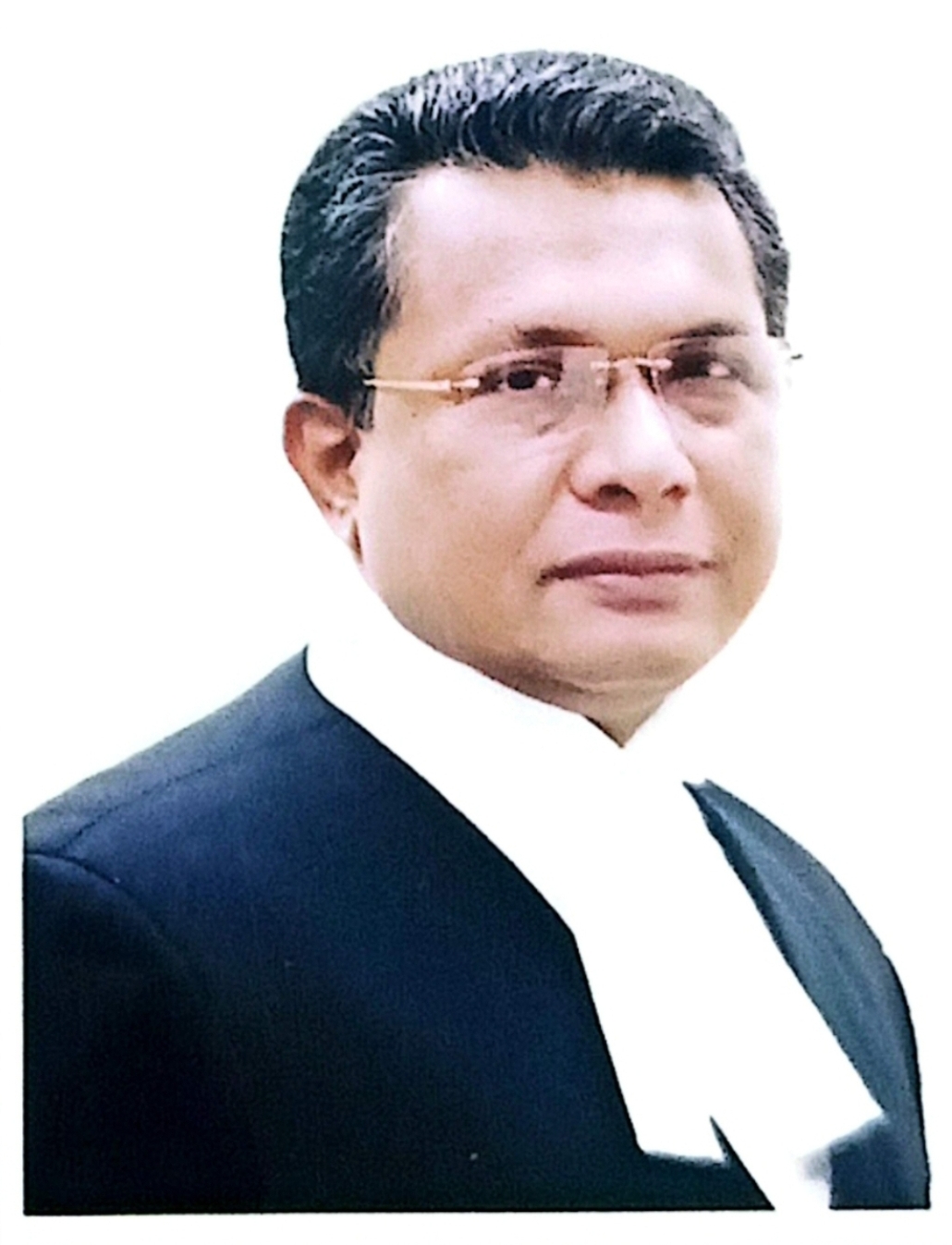
Justice Muhammad Khurshid Alam Sarkar
Former Judge, High Court Division, Supreme Court of Bangladesh, Honorable Society of Gray’s Inn.
LL.B (Hons), LL.M — University of Dhaka · LL.B (Hons), UK ·
Justice Muhammad Khurshid Alam Sarkar (who is popularly known as Justice Khushi or Barrister Khushi) excelled in his primary and secondary education at various educational institutions in his native Upazilla Headquarters (Fulchari Government Primary School, Fulchari Pilot High School and Fulchari Madrasa). In 1985, he was admitted to the prestigious Dhaka College, one of the top institutions for intermediate-level education in Bangladesh, where he completed Higher Secondary certificate (HSC) course in 1987 securing First Division. Thereafter, he pursued an LLB (Hons.) and LLM from the University of Dhaka securing higher second class marks. Later, he obtained another LLB (Hons.) degree from the UK and was called to the Bar of England and Wales by the Honourable Society of Gray's Inn. Justice Sarkar started to actively practice the legal profession after being enrolled as an Advocate on 01.04.1995. Subsequently Justice Sarkar obtained permission to practice before the Hon'ble High Court Division of the Supreme Court of Bangladesh on 07.03.1996 and, thereafter, gained the right of audience before the Hon'ble Appellate Division of the Supreme Court of Bangladesh on 24.08.2010. He was appointed as an Assistant Attorney General for Bangladesh in the year 2001 during the Non-political Caretaker Government when he had served for less than a year and was again appointed as a Deputy Attorney General for Bangladesh in the year 2009 but voluntarily resigned after about a year to focus on his flourishing legal practice and thriving business ventures. Subsequently, Justice Sarkar was sworn in as a Judge of the Supreme Court of Bangladesh on 20th October, 2011. As a Supreme Court Judge, Justice Sarkar has had the opportunity to handle a diverse array of cases on the Bench. Although he is adept at dealing with all kind of cases, i.e. Civil, Criminal and all types of Writ matters (judicial review applications), he specializes in corporate/commercial matters, in particular, in the matters arising out of Artha-Rin Act, Banking Company Law, Trade Mark Act, VAT Act, Customs Act, Tax Law, Arbitration Law, Admiralty Law and Company Law. While he was in charge of the Company Bench of the High Court Division (commonly called the 'Company Court'), Justice Sarkar had the occasion to pass a number of innovative Judgments and Orders, which saved many publicly listed companies, especially Banks and Financial Institutions, from collapse. In order to protect the interest of the country's economy, he was not hesitant to pass Orders of Arrest against the perpetrators of financial scams (such as Mr. PK Halder and his cohorts), seize their passports, and impose injunctions upon their banking transactions and the selling of their properties. He was bold enough to conduct investigations into these Financial Companies with an aim to find out the culprits behind these financial scams. As a result of his well-crafted Orders, the country managed to avoid a loss of about 30 (thirty) thousand crores of Taka (Taka 300 billion). Also, pursuant to the strict judicial oversight of the Company Court presided over by Justice Sarkar, the tendency of Financial Institutions to lend money without taking sufficient collaterals was largely curbed. Justice Sarkar has delivered scores of Judgments on the laws related to companies, which include the Companies Act, 1994, the Banking Companies Act, 1991, Financial Institutions Act, 1993 (amended as Financial Companies Act, 2023); more than a hundred of which have been published in various law reports of Bangladesh. When a number of Financial Institutions' shareholder-Directors fled the country following embezzlement of thousands of crores of Taka or were incommunicado, and Bangladesh Bank, standing as a petitioner, approached the Company Court to wind up the said Financial Institutions, Justice Sarkar turned down the Bangladesh Bank's prayer and opted to keep the companies as running concerns by appointing for each of the aforesaid Financial Institutions a fresh Board of Directors with persons having vast experience and track record of integrity and, that is how, he made an admirable endeavour to protect the livelihood of employees as well as to give ordinary depositors and shareholders an opportunity to recover their investments. In the absence of any clear-cut provision in the Companies Act or in any case-law of the Apex Court as to under what authority the Company Court can constitute a partial or full Board of Directors of a company, Justice Sarkar, in the cases of Nahid Sarwar Vs. RJSC and another, Biplob Bikash Shill and others Vs. Destiny-2000 Ltd. and others, Tees Mart Inc. Vs. BIFC Ltd. and Mr. Abdus Salam Murshedy Vs. Envoy Textiles Limited and others, laid down the scope for formation of a Board of Directors, upon explaining the authority/power of the Company Court.
Mr. Justice Sarkar in interpreting and applying different provisions of the Companies Act, 1994, for the first time in the jurisprudence of Company Law, employed the words "Ombudsman of the Corporate Sector" to make the Company Bench's Orders/Directions effective. Though the Company Court has been receiving donations for more than hundred years, yet very often people become inquisitive to know the Company Court's authority to take donations from the companies. To put an end to the aforesaid query, Justice Sarkar initially sought to enlighten the stake-holders by making brief observations in the case of Kay and Que (Bangladesh) Limited Vs. RJSC, and, later on, by writing an article under the title "Donations through the Company Court: Legal Procedures and Practice". Sitting on the specialized Single Bench with jurisdiction over Arbitration Cases (both International Commercial Arbitration cases and Domestic Arbitration cases), Justice Muhammad Khurshid Alam Sarkar handed down a number of Judgments. In the case of Corona Fashion Ltd Vs. Milestone Clothing Resources LLC, Justice Sarkar adjudicated upon the issues (i) whether the Court should examine the issue of 'existence of an arbitration agreement' in an application under Section 12 of the Arbitration Act, (ii) difference between 'arbitration agreement' and 'valid arbitration agreement', (iii) whether Sections 12 & 17 of the Arbitration Act are in conflict with each other, (iv) what 'Documentary Collection' means and (v) whether arbitration may be invoked for the disputes arising out of Letter of Credit (L/C) or Documentary Collection. In the case of Southern Solar Power Ltd Vs. BPDB, Justice Sarkar has meticulously explained the scheme of ushering Arbitration law in Bangladesh upon defining the words 'arbitration' 'international commercial arbitration', 'foreign arbitration', 'bank guarantee', letter of credit'. He resolved the much-debated issues like what the jurisdictions of the Courts in arbitration matters are and, secondly, whether the High Court Division in exercising its jurisdiction under Section 7A of the Arbitration Act is competent to pass any interim Order where the arbitration is being or would be held outside Bangladesh. In another case, Ghulam Mohiuddin Vs. Rokeya Din(Para 36), Justice Sarkar laid down the law that when a party before the arbitral tribunal does not raise any objection with regard to non-compliance of any provision of the Arbitration Act or with regard to non-fulfillment of any requirement set out in the arbitration agreement within the time prescribed in the Arbitration Act and/or within the time-limit stipulated in the arbitration agreement or, in the absence of any stipulation as to the time in the law or in the arbitration agreement, within a reasonable time without making any delay, for dealing with that scenario, the Legislature mandated the arbitral tribunal and the Courts to take a presumption that the aforesaid party has waived his right to so object. Justice Sarkar interpreted the provisions of Sections 20 and 53 of the Arbitration Act stating that once a party to an arbitration agreement approaches any Court, all the parties to the said arbitration agreement shall have to go to that Court for filing any additional or consequential or ancillary or any independent application, until the arbitral proceedings finally comes to an end and, also, pronounced that the specific jurisdictions conferred upon the High Court Division are not meant to have been taken away by the provisions of Section 53 of the Arbitration Act. In the case of Frigo Mekanik Vs. BD Milk Producers, Justice Sarkar answered the issues (i) whether any party to an arbitration agreement can adjudicate upon their dispute through Court, bypassing the arbitration tribunal and (ii) whether the provisions of the Arbitration Act are applicable in an International Arbitration. In another case, Agro Crop International Pte Ltd Vs. Vietnam Northern Food Corporations, Justice Sarkar pronounced that without the existence of an arbitration agreement between the parties, the entire provisions of Section 12 of the Arbitration Act would have no application. In another case, ABB India Ltd Vs. Power Grid Company, Justice Sarkar expounded the status of 'Bank Guarantee' as an agreement between a Bank and its customer with reference to the provisions of ICC Uniform Rules for Demand Guarantees (URDG-758). In a recent case, DNCC Vs. District Judge, Justice Sarkar illustrated the principles of arbitration regarding at what stage the parties need to approach the High Court Division/the District Judge Court for appointment of arbitrator/s, secondly, whether the parties to the arbitration require to supply name/s of the arbitrator/s to the High Court Division/the District Judge Court for filing a Section-12 application and, thirdly, why the High Court Division/the District Judge Court is not bound to form tribunal as per the suggestions put forward by the parties.
By negating the fallacy existed in the field of arbitration law of Bangladesh for decades that the factual aspect of the arbitral tribunal's award (i.e. the merit of the award) is not touchable by the Court, Justice Sarkar ruled that merit (factual aspect) of an arbitration award can be interfered with by the Court if the tribunal's findings are found to be 'perverse findings'. Sitting on specialized Writ Bench (having jurisdiction over VAT, Customs, Tax, Artha-Rin, Banking Company and Trade Mark related matters), Justice Sarkar has not only issued various strategic Orders against the revenue-evasion to compel the evaders to pay the appropriate revenue, but he has also passed appropriate Orders directing the concerned Commissioners and Deputy Commissioners of VAT, Customs and Tax not to harass the traders. In loan recovery matters, whenever any Decree of the Artha-Rin Adalat is challenged in the Writ Bench of Justice Sarkar, he accepts the Writ Petition on the condition of payment of 50% of the amount decreed by the Adalat and, in the event of challenging any Order of the Artharin Adalat, Justice Sarkar has fashioned the relief of granting remedy on the condition of payment of 25% of the bank's dues. Such orders have resulted in hundreds of crores of defaulted loans being recovered while at the same time allowing borrowers to protect their properties from being sold on auction. In Bangladesh, the activities of the Insurance Companies (both life insurance companies and non-life insurance companies) are governed and regulated by the Insurance Act, 2010, Insurance Development Regulatory Authority (IDRA) Act, 2010 and the Rules and Regulations framed/made under the aforesaid 2 (two) Acts of Parliament. A confusion was prevalent for years among the lawyers and the corporate sector of Bangladesh as to whether the Insurers (insurance companies) and the Insured (policy holders/consumers) are mandatorily obligated to approach the forum, namely, 'Dispute Resolution Committee' (বিরোধ নিস্পত্তি কমিটি 'বিনিক') created by the aforesaid two Acts of Parliament when a dispute regarding an insurance claim of an amount of more than Tk. 5,00000/- (Taka five lacs) arises, or, in the alternative, the parties may opt to resolve the dispute among them by formation of an arbitration tribunal under the Arbitration Act. Justice Sarkar put an end to the dilemma by pronouncing that it is the 'Dispute Resolutions Committee' which has been created by the Legislature as a special forum; that is invested with the power to resolve disputes among the insured and insurers. In the field of intellectual property law, Justice Sarkar has had the opportunity of delivering a seminal Judgment with regard to the protection of unregistered trademarks. By a landmark Judgment, Justice Sarkar held that a domestic or foreign trademark which has gained worldwide reputation, even though not registered in Bangladesh, was entitled to be protected against registration of a deceptively similar mark in the name of another concern/company. Justice Sarkar has delivered many Judgments in the Admiralty Bench, in particular, with regard to circumstances in which a ship may be ordered to be laid up. In a number of lucid Judgments, Justice Sarkar has expounded globally accepted principles in settling the law relating to arrest of ships. In particular, he has laid down the principle that Admiralty Court is competent to arrest a ship (a) for non-payment of wages to the master and crew, (b) for causing damage to a ship by a collision with another ship, or (c) when a creditor from any part of the world brings a claim against the ship/ship owner, especially claims for delivery of oil, food and other goods to ships, claims for repair of ships, or (d) if the ship is taking preparations for leaving Bangladesh without the importer's goods being delivered. Justice Sarkar has also delivered a number of important rulings on the kind of debts the ship itself would be obliged to pay where the ownership of the ship changes. Over the last decade, Justice Sarkar has had the opportunity of delivering many ground-breaking Judgments as a member of the Constitutional Bench [i.e., while sitting on the Writ Bench (General)]. Many of his Judgments have been published in various law reports, some of which are highlighted below:
(i) In a Judgment spanning over 200 pages, Justice Sarkar ruled on the validity of the 10th Parliamentary elections held on 5th January 2014, which involved interpretation of various provisions of Representation of the People Order, 1972 (widely known as PO 155 of 1972) and the Constitution of Bangladesh. In the field of administrative law, Justice Sarkar has laid down in clear terms the principle that whenever any public authority, in particular a constitutional body, is vested with discretionary power, it is expected that such powers should be exercised judiciously and prudently.
(ii) In a much-discussed Case, Justice Sarkar ordered the arrest and detention of members of law enforcement agencies involved in the murder of seven innocent citizens on the outskirts of the Narayangonj City. The Order for arrest was passed against highly placed officials of the Rapid Action Battalion (RAB) who were very influential people of the regime and, consequently, Justice Sarkar had to pass through an adverse period.
(iii) In the field of education, Justice Sarkar passed a landmark Judgment which granted relief to candidates who had failed entrance examinations to medical colleges on account of errors in the question papers. In a Judgment spanning over 60 (sixty) pages, Justice Sarkar ruled that if any student is denied the opportunity of admission to Government Medical Colleges due to errors of Doctors/Teachers/Government Officials (who were responsible for preparing question papers), then the said responsible Doctors/Teachers/Government Officials shall bear the costs of admission of those candidates to private medical colleges. Justice Sarkar's Judgment was affirmed by the Hon'ble Appellate Division.
(iv) Justice Sarkar has played an important role in reining errant private universities involved in opening unauthorised branches in different parts of the country and admitting thousands of students in various subjects in violation of rules and regulations. In the face of widespread academic irregularities and fraud committed by Darul Ihsan University (a private university) in 'selling' certificates of completion of undergraduate degree to 'students', Justice Sarkar ruled that the university in question was not a university in the eye of the law. In a landmark Judgment, Justice Sarkar laid down the conditions to be observed for establishment of private universities, the procedure for admission of students, and the maximum number of students to be admitted to LLB (Hons) courses every year.
(v) Public Interest Litigation (PIL) tends to be abused in Bangladesh, being used more often as a tool for publicity than for vindicating a public cause. To prevent such abuse, Justice Sarkar laid down various conditions/requirements for filing a Public Interest Litigation (PIL) together with the qualifications of the public interest litigant.
(vi) Justice Sarkar's numerous Judgments on the scope of judicial review under Article 102 of the Constitution have helped shape the law on the subject. In a recent Judgment, he declared that a Writ of Quo Warranto is maintainable challenging the office of a Member of Parliament (MP) if he is a loan-defaulter and, also, delineated the requirements for filing a Writ of Quo Warranto. In another writ petition, Justice Sarkar laid down important principles for interpretation of the Constitution. He held that the Constitution must be read and understood in its existing form without importation of any word to render the Constitution more pro-people, unless the same is amended by the Parliament. In yet another Writ Petition, Justice Sarkar delivered a Judgment setting out the differences between sub- Article (1) and sub-Article (2) of Article 102 of the Constitution. Recently, Justice Sarkar delivered a Judgment on the conditions that must be fulfilled for challenging the vires of the law this is an important Judgment and is likely to hold the field for many years to come. In a Judgment which has potentially expanded the scope of judicial review, Justice Sarkar pronounced that there are a number of exceptional circumstances when an aggrieved person may directly invoke Article 102(2) of the Constitution despite the availability of an alternative forum. In order to prevent the abuse of the constitutional jurisdiction, Justice Sarkar declared that all Government servants are required to approach the Administrative Tribunal for remedy regarding service-related grievances, and that a Writ Petition was not maintainable for agitating such grievances. For recovery of contractual amount invoking writ jurisdiction, Justice Sarkar laid down the principle that if the writ petitioner can satisfy the High Court Division that the (1) contract is not a commercial one: (2) the amount is admitted and (3) it is a statutory payment which emanates from a statutory contract, the writ jurisdiction can be invoked.
(vii) While on the Constitutional Bench, Justice Sarkar has used his powers to ensure that the Election Commission discharges its constitutional functions in a fair and independent manner. Justice Sarkar laid down numerous guidelines regarding the manner of holding inquiry and adjudication of election-related offences. In yet another case, Justice Sarkar in no uncertain terms set out the constitutional duties that are required to be discharged by the Election Commission.
(viii) Justice Sarkar has, at all times, tried to exercise the powers of the Constitutional Bench in the public interest.
. At the same time, where State-functionaries are found to act negligently, Justice Sarkar passed Orders for investigating into allegations of negligence, and in the event of repeated instances of negligence, directed that delinquent public officials pay the fine from their own pockets thereby ensuring that there was no financial loss to the State. Generally, Judges who specialize in constitutional and commercial cases, are not known to be particularly adept at civil and criminal matters. However, Justice Sarkar has demonstrated his versatility on the Bench by exhibiting commendable proficiency in the civil and criminal jurisdiction as well. While exercising his powers in the Civil Bench, Justice Sarkar has laid down important principles regarding the circumstances in which the plaint may be rejected outright, the manner of impleading parties to a civil suit, and the circumstances in which a suit may be restored. Justice Sarkar has also delivered detailed Judgments on the law of partition of immovable property and the law of adverse possession, various aspects of the law of pre-emption, the principles of estoppel under section 115 of the Evidence Act, 1872, and various aspects relating to the transfer, registration and mutation of immovable property. In a recent landmark Judgment delivered regarding execution cases, Justice Sarkar interpreted Order XXI, rules 43, 68, 69, 77, 78 and 79 of the Code of Civil Procedure, 1908 and held that once an auction-sale has been confirmed by the executing Court upon being satisfied that the auction purchaser has complied with the Court's Order, there is no scope for the executing Court to do any favour to the Judgment debtor. Justice Sarkar has also had the occasion to deliver many landmark Judgments in the criminal jurisdiction. While sitting in the Criminal Bench, Justice Sarkar delivered Judgments on a wide range of issues of public importance, some of which are highlighted below:
(i) He was instrumental in unravelling the mystery surrounding the murder of Jalaluddin Talukder, a wounded freedom fighter and several-time Member of Parliament (MP) of Netrakona district. During the first investigation by the police, the only son of the deceased was charged as the murderer of his father. Following the deceased's son's objections, Justice Sarkar ordered a Judicial Inquiry which revealed that the second wife of the deceased was involved in the murder.
(ii) The investigation into the murder of the Mayor of Narsingdi Municipality raised more questions than it answered. The deceased's family members were unhappy with the investigation report and approached the High Court Division with a prayer for conducting further investigation in the hope of finding the real culprits. Upon elaborately discussing the principles of 'Further Investigation', Justice Sarkar ordered for further investigation of the case.
(iii) In numerous Judgments, Justice Sarkar has laid down guidelines for invoking sections 144 and 145 of the Code of Criminal Procedure ('CrPC'), the principles and circumstances relating to quashing of Complaint Cases, the procedure and preconditions for filing a case under Section 138 of the Negotiable Instrument Act, 1881, and the meaning of the popular phraseologies of criminal law, i.e., 'FIR', 'Police Report', 'Charge Sheet', 'Final Report', 'Further Investigation', 'Naraji Application' and Examination of a complainant' under Section 200 CrPC.
(iv) Moreover, in a landmark case, Justice Sarkar gave an expansive interpretation to section 561A of the Code of Criminal Procedure, 1898 holding that in exceptional circumstances, the High Court Division may direct the Magistrates to take cognizance. In yet another ground-breaking Judgment, Justice Sarkar held that the filing of a complaint petition on behalf of the aggrieved person under Section 500 of the Penal Code is permitted, subject to fulfillment of certain conditions.(v) One of the most debated issues in criminal jurisprudence is whether 'sentence' and 'conviction' can be stayed; this was finally resolved by Justice Sarkar in the context of contesting elections to Parliament. He has also settled the issue of whether an absconding-convict is competent to invoke Section 561A of the Code of Criminal Procedure. In a recent case, Justice Sarkar held that at the stage of framing charge (either under Section 241A or 265C of the CrPC), the defence version should not be taken into consideration for discharging an accused. In addition to performing his judicial functions, Justice Sarkar occasionally delivers lectures on legal issues of public importance. He is highly respected by members of both the Bar and the Bench. His Judgments on civil, criminal, constitutional and commercial law are expected to have a lasting impact on the jurisprudence of Bangladesh.